No products added!

Price range: $135.99 through $235.99
From Africa, the Dybowski’s Twinspot (Euschistospiza dybowskii) are found in the grass between rocks on riverbanks and on the edge of forests and other dense vegetation. Nests are typically low to the ground. These birds like cover and highly appreciate to take their nap well hidden in thicket and get quite tame when they can retrieve to safety under dense cover. Dybowski’s Twinspots prefer an aviary but if they are in a cage, it should be large enough to get one corner decorated with either artificial plants or cuttings.
The Dybowski’s Twinspot (Euschistospiza dybowskii) is a beautiful African finch known for its striking colors, shy nature, and preference for dense vegetation. These birds are found among grasses and rocks along riverbanks, as well as near forest edges and areas with thick vegetation.
Dybowski’s Twinspots enjoy having plenty of cover where they can retreat and feel secure. They often rest quietly in dense foliage and may become quite tame when they have a safe, sheltered environment.
At Aviora Haven, we recommend providing Dybowski’s Twinspots with a spacious, well-planted aviary whenever possible. If kept in a cage, it should be large enough to provide adequate flying space and include a sheltered corner with artificial plants or natural cuttings.
Africa — Eastern Sierra Leone through Nigeria and Cameroon to northeastern Congo
The Dybowski’s Twinspot has a soft and distinctive call. Providing a calm environment with suitable vegetation allows these birds to display more natural behaviors and vocalizations.
Approximately 4.75 inches / 12–14 g
Dybowski’s Twinspots are sexually dimorphic, with noticeable differences between males and females.
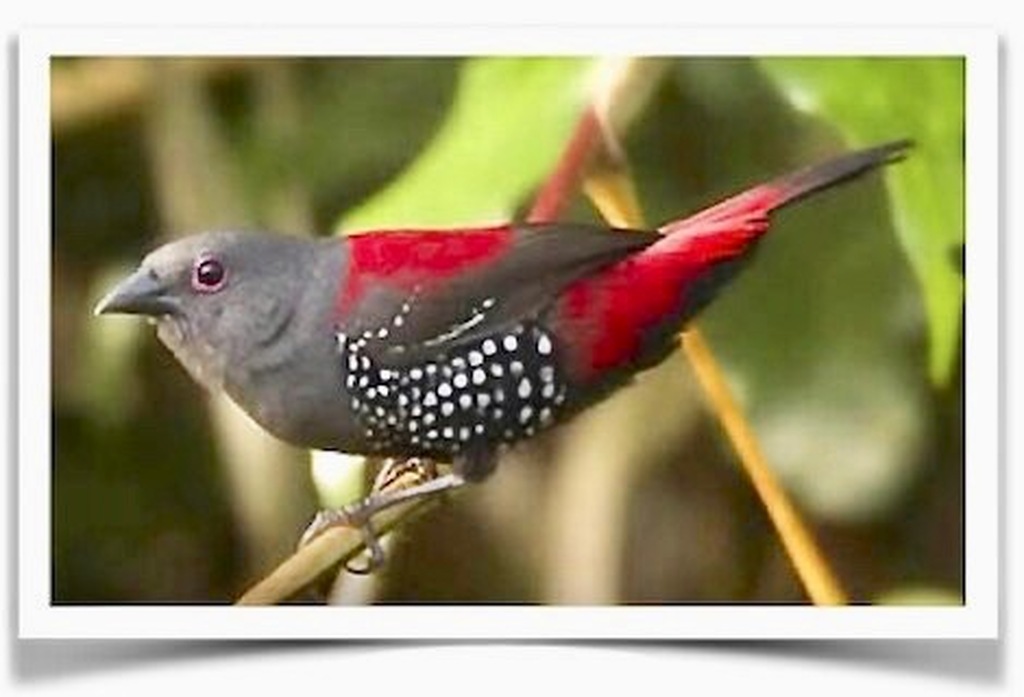
The male has dark gray coloration from the head through the neck and breast, with crimson upperparts, rump, and upper tail coverts. The lower breast and undertail area are black, while the flanks feature distinctive white spots. The eyes are dark brown to reddish-brown with a reddish-pink eye ring. The bill is black, as are the legs.
The female is generally paler. Her chin and breast are lighter gray, while the lower underparts, flanks, and undertail coverts are softer gray tones.
Dybowski’s Twinspots are generally quiet and reserved, but males can become territorial and aggressive, particularly during the breeding season.
Although they may be kept with other compatible finches, the safest approach is often to provide one aviary or enclosure per pair. Avoid placing unpaired or extra birds with a breeding pair, as territorial disputes can result in stress or injury.
Providing dense vegetation, visual barriers, and plenty of space can help reduce conflict.
The best breeding results are generally achieved in a well-planted aviary. Breeding can be less reliable when these birds are kept indoors in smaller cages.
Provide a combination of low and taller shrubs, grasses, and other vegetation to create a natural environment. During courtship, the male may hold a piece of grass or a feather in his bill while hopping around the female. He may raise his belly feathers, hold his head upward, bob up and down, and sing. During ground displays, he may spread his tail so that it touches the ground.
The nest is usually a loosely constructed ball made from dry grass and plant fibers and lined with feathers. Nests built on the ground may have an entrance tube, while nests placed higher in shrubs or ferns may lack one.
A typical clutch contains 4–6 eggs, with an incubation period of approximately 13–14 days.
10+ years
A varied diet is important for keeping Dybowski’s Twinspots healthy and active. Suitable foods can include:
Live food is especially important during the breeding season, when adults need additional protein to support breeding and chick development.
If there is no gender option listed for a bird on our website, that species may be considered monomorphic, meaning its gender cannot be reliably determined visually.
DNA testing is available for an additional $149 per bird to help guarantee the preferred gender. Testing may add approximately 3–6 or more weeks to the estimated delivery time while the gender results are obtained. Please see our FAQs for additional information.
The Dybowski’s Twinspot can be a rewarding aviary bird for experienced keepers who can provide plenty of cover, space, privacy, and an appropriate diet. Aviora Haven recommends paying particular attention to their need for dense vegetation and careful pair management, especially during breeding season.
| Sex | Male, Female, Pair |
|---|
Reviews
There are no reviews yet.